1. What Is a Biomass Pellet Plant ?
A biomass pellet plant is a manufacturing unit that converts organic raw materials — such as sawdust, rice husk, groundnut shells, cotton stalks, bagasse, or wood chips — into compressed cylindrical fuel pellets.
These pellets are then used as fuel in boilers, furnaces, kilns, dryers, and industrial burners as a clean, cost-effective alternative to coal, diesel, and LPG.
2. Step-by-Step: How to Set Up a Biomass Pellet Plant in India
Follow these eight steps to build a profitable and legally compliant biomass pellet plant in India.
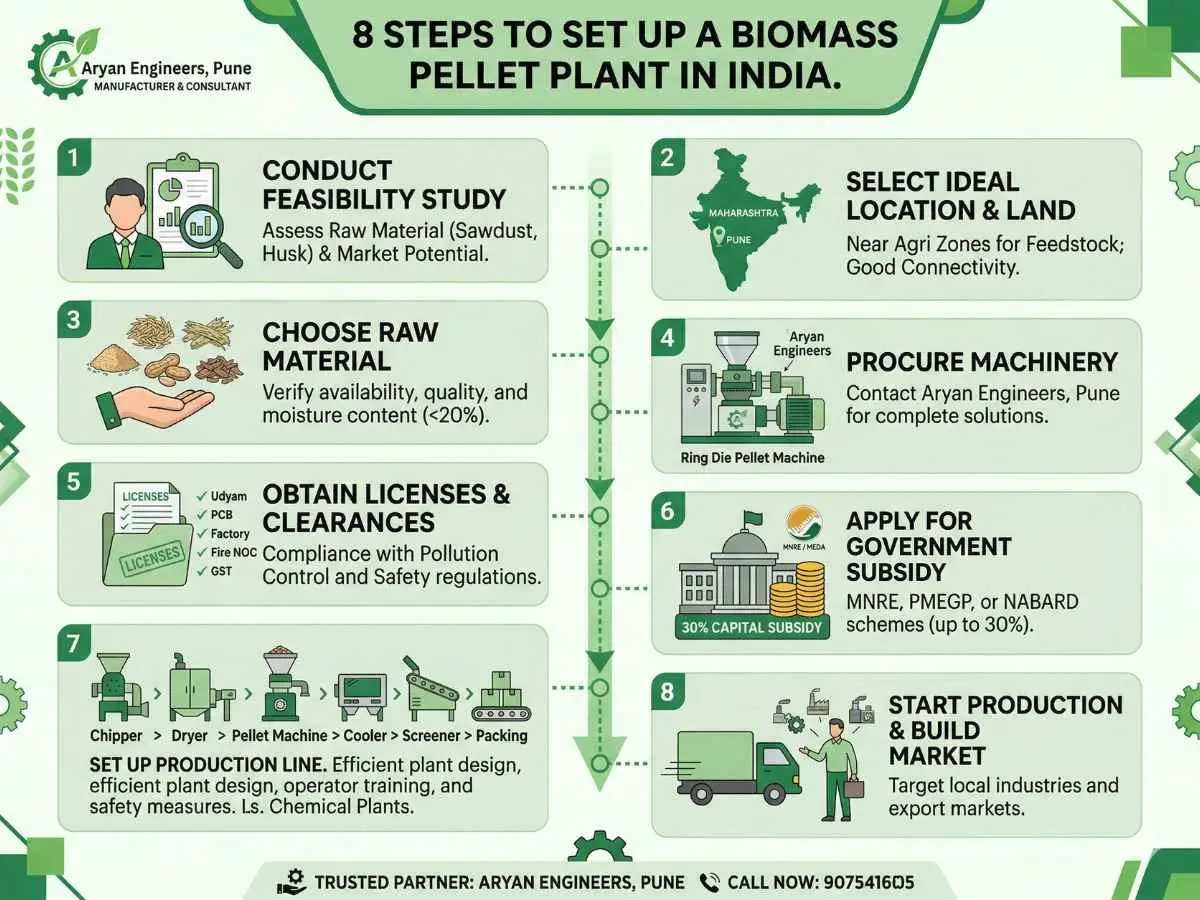
Conduct a Feasibility Study & Business Plan
Analyse raw material availability within 50–100 km, estimate production capacity (500 kg/hr to 5 TPH), identify buyers (power plants, industries, exporters), and calculate capital investment vs projected revenue.
Select the Right Location & Land
A pellet plant of 500 kg/hr capacity needs approximately 2,000–3,000 sq. ft. of covered area. Choose a location near agricultural zones for cheap raw material access. Pune, Nagpur, Nashik, and Aurangabad are ideal in Maharashtra.
Choose Your Raw Material
Best raw materials in India: sawdust, rice husk, groundnut shells, sugarcane bagasse, cotton stalks, wheat straw, and wood chips. Moisture content must be below 20% before processing.
Procure the Right Machinery
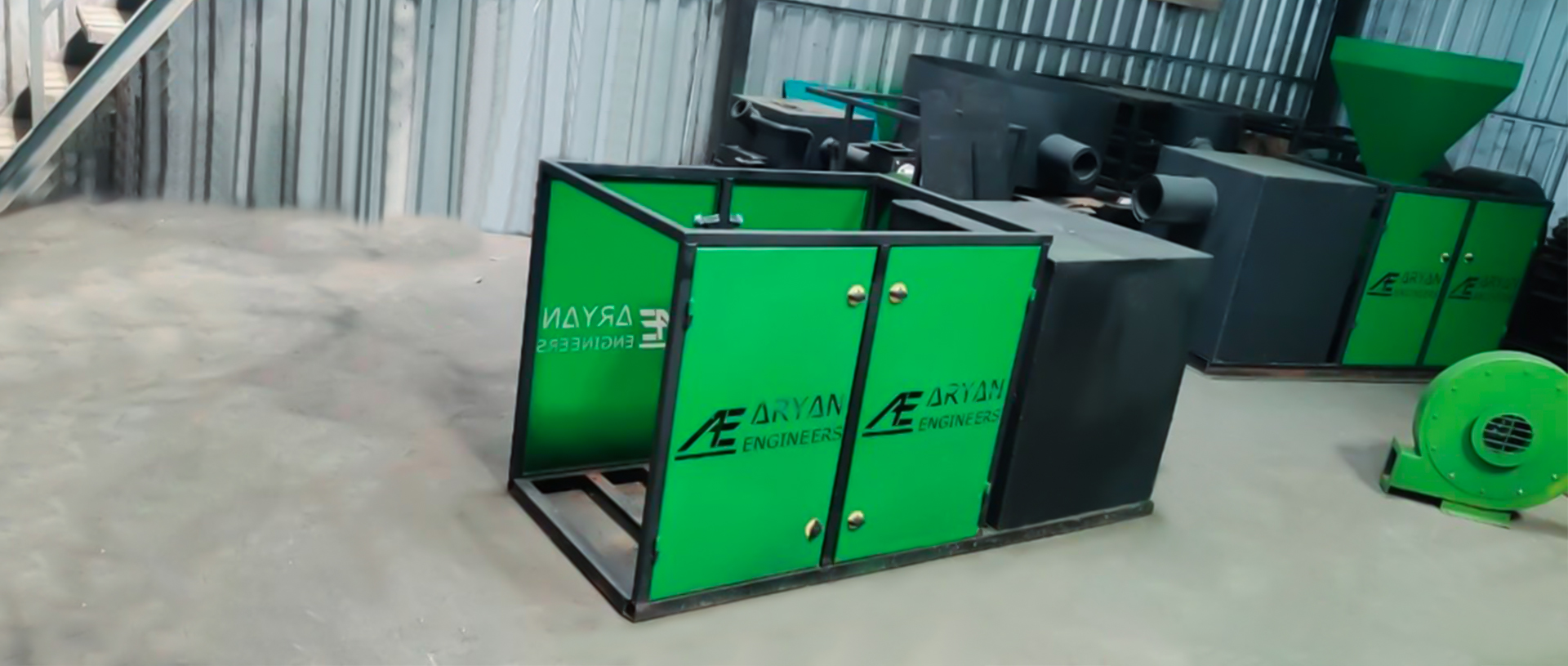
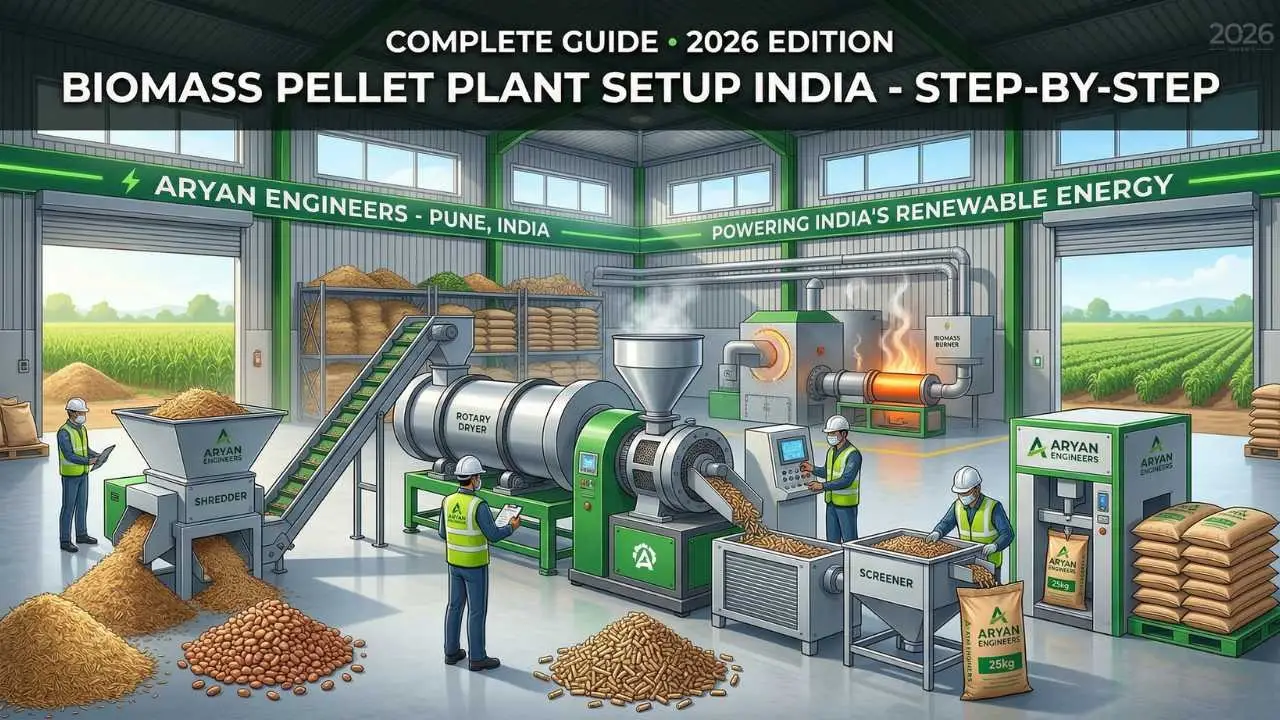
Key machines required: chipper/shredder, rotary dryer, biomass pellet machine (flat die or ring die), pellet cooler, screener, and packaging unit. Contact Aryan Engineers, Pune for complete plant supply.
Get Required Licenses & Clearances
Register your business (Udyam/MSME), obtain factory license, PCB (Pollution Control Board) consent, fire NOC, electricity connection (3-phase), and GST registration.
Apply for Government Subsidies
MNRE provides capital subsidy up to 30% for biomass energy projects. PMEGP, NABARD, and state government schemes also offer financial support. Apply through your district DIC office.
Set Up the Production Line & Staff
Install machinery in sequence: shredder > dryer > pellet machine > cooler > screener > packaging. Hire 4–6 operators for a 500 kg/hr unit. Train staff on machine operation and safety.
Start Production & Build Your Market
Target buyers: thermal power plants (co-firing mandate), food processing industries (burner fuel), chemical plants, textile units, and export markets (EU biomass demand is booming).
3. Choosing the Right Raw Material for Your Pellet Plant
Raw material is the single biggest cost driver in pellet production. Choosing the right biomass ensures consistent pellet quality and maximum profitability.
| Raw Material | Calorific Value | Availability in India | Pellet Quality |
|---|---|---|---|
| Sawdust | 4,200–4,600 kcal/kg | Excellent (saw mills) | Premium |
| Rice Husk | 3,200–3,500 kcal/kg | Excellent (agri zones) | Good |
| Groundnut Shell | 4,000–4,200 kcal/kg | Very Good (Gujarat/MH) | Premium |
| Cotton Stalks | 3,600–3,800 kcal/kg | Very Good (Vidarbha) | Good |
| Sugarcane Bagasse | 2,800–3,200 kcal/kg | Excellent (UP/MH) | Moderate |
| Wood Chips | 4,400–4,800 kcal/kg | Good (forest areas) | Premium |
4. Machinery Required for a Biomass Pellet Plant
A complete biomass pellet production line consists of several machines working in sequence. Here is what you need for a standard 500 kg/hr plant :
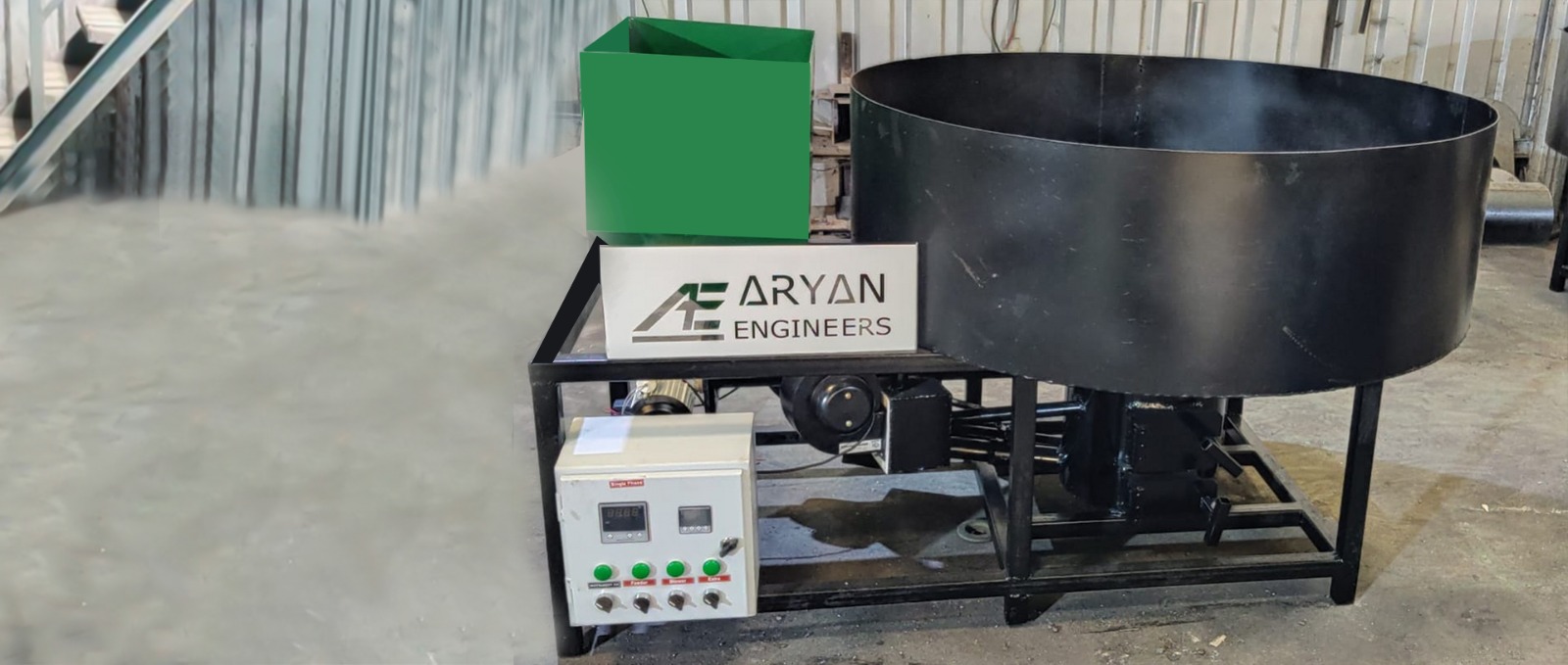
Biomass Wood Pellet Machine (Pellet Mill)
- • Flat Die Pellet Machine — Ideal for small to medium capacity (200–800 kg/hr). Lower capital investment. Best for sawdust, rice husk, and agri-waste.
- • Ring Die Pellet Machine — Best for large-scale production (1–5 TPH). Higher output and consistency. Preferred for commercial and export pellet units.
Related reading: Learn more about our Biomass Wood Pellet Machine at Wood Pellet Machine
Biomass Dryer (Rotary Drum Dryer)
Raw biomass typically contains 30–50% moisture. The rotary dryer reduces moisture to below 10–12%, which is essential for producing hard, durable pellets. A properly dried raw material also reduces energy consumption in the pellet mill.
Hammer Mill / Crusher
Raw biomass must be crushed to a particle size of below 5 mm before pelleting. A hammer mill or shredder is used for size reduction. For wood logs and thick agricultural waste, a chipper is required as the first step.
Pellet Cooler
Hot pellets exiting the pellet mill are soft and prone to breakage. A counter-flow pellet cooler reduces the pellet temperature from approximately 80–90°C to room temperature, hardening them and making them suitable for storage and transport.
Pellet Screener & Bagging Unit
A rotary screener separates fine powder (which is recycled) from finished pellets. A semi-automatic or automatic bagging unit then packs pellets into 25 kg or 50 kg bags for dispatch.
Biomass Pellet Burner (For In-Plant Energy Use)
A Biomass Wood Pellet Burner can power your own dryer and other heating equipment within the plant, significantly reducing your energy cost. Aryan Engineers manufactures high-efficiency pellet burners for industrial use.
Related reading: Learn more about our Biomass Wood Pellet Burner at Wood Pellet Machine
5. Investment & Cost Breakdown for a 500 kg/hr Pellet Plant
Here is a realistic cost estimate for setting up a biomass pellet plant with a capacity of 500 kg/hr in India (2026 prices) :
| Cost Component | Min. Estimate (INR) | Max. Estimate (INR) |
|---|---|---|
| Pellet Machine (500 kg/hr) | ₹4,00,000 | ₹8,00,000 |
| Rotary Drum Dryer | ₹2,50,000 | ₹5,00,000 |
| Hammer Mill / Chipper | ₹80,000 | ₹1,50,000 |
| Pellet Cooler + Screener | ₹80,000 | ₹1,50,000 |
| Bagging & Conveyor System | ₹60,000 | ₹1,20,000 |
| Civil Work & Shed Construction | ₹3,00,000 | ₹6,00,000 |
| Electrical Setup (3-phase) | ₹1,00,000 | ₹2,00,000 |
| Working Capital (3 months) | ₹2,00,000 | ₹4,00,000 |
| Total Estimated Investment | ₹14,70,000 | ₹29,20,000 |
6. Government Subsidies & Schemes for Biomass Pellet Plants in India (2026)
The Indian government actively promotes biomass energy projects through multiple financial support schemes. Here are the key schemes you should explore:
- MNRE Capital Subsidy — The Ministry of New and Renewable Energy (MNRE) provides up to 30% capital subsidy on biomass power projects, including pellet production plants. Apply through your State Nodal Agency (in Maharashtra: MEDA — Maharashtra Energy Development Agency).
- PMEGP (Prime Minister's Employment Generation Programme) — Provides 15–35% subsidy on project cost for manufacturing businesses. A pellet plant qualifies under the green manufacturing category. Apply through KVIC or district DIC.
- NABARD Rural Energy Scheme - For farmers and rural entrepreneurs, NABARD offers low-interest loans and partial subsidies for agro-waste based energy projects.
- SATAT Scheme — Primarily for compressed biogas, but biomass pellet by-products and co-processing units may qualify for linked support under this scheme.
- State Government Incentives (Maharashtra) — Maharashtra offers electricity duty exemption, stamp duty exemption, and industrial promotion subsidies for new manufacturing units under the Maharashtra Industrial Policy.
7. Licenses & Approvals Required to Start a Pellet Plant in India
Obtaining the correct clearances before starting production is essential to avoid legal complications.
- MSME/Udyam Registration - Register your business online at udyamregistration.gov.in. This is mandatory for accessing government subsidies.
- Factory License - Apply to your state's Labour Department under the Factories Act if your plant employs more than 10 workers.
- Pollution Control Board (PCB) Consent - Obtain Consent to Establish (CTE) and Consent to Operate (CTO) from the Maharashtra Pollution Control Board (MPCB) for Pune/Maharashtra-based plants.
- Fire Department NOC - Required due to the combustible nature of biomass raw materials.
- GST Registration - Biomass pellets attract 5% GST. Register on the GST portal before starting commercial sales.
- Electricity Connection - A 500 kg/hr plant typically requires 50–75 kW of 3-phase power. Apply through your local MSEDCL office in Maharashtra.
8. Why Choose Aryan Engineers for Your Pellet Plant Machinery ?
Aryan Engineers is a Pune-based manufacturer of Biomass Wood Pellet Machines and Biomass Wood Pellet Burners, serving industries across Maharashtra and India since 2016.
Local Manufacturer Advantage
Located in Pimpri Chinchwad, Pune — faster delivery, lower freight cost, and easy access to after-sales support across Maharashtra.
End-to-End Support
From machine selection and installation to operator training and spare parts supply — Aryan Engineers supports you at every stage.
Custom Capacity Options
Machines available from 200 kg/hr to 2 TPH to suit your budget and scale.
Proven Track Record
Trusted by clients across food processing, dal mills, namkeen manufacturers, boiler operators, and agri-entrepreneurs in Maharashtra and beyond.
Biomass Burner Integration
Aryan also supplies Biomass Wood Pellet Burners for industrial heating applications — enabling you to use your own pellets as fuel and cut energy costs significantly.
Call Now: 9075416505 | Get a Free Quote at aryanengineers.net.in
Frequently Asked Questions (FAQ)
These are the most commonly asked questions about setting up a biomass pellet plant in India.
Conclusion
Setting up a biomass pellet plant in India in 2026 is one of the most promising green business opportunities available today. With government mandates driving demand, abundant agricultural raw materials, and a growing export market, the economics are compelling.
The key to success lies in choosing the right machinery, securing the right raw material supply, and leveraging available government subsidies. Whether you are starting with a 200 kg/hr unit or planning a 2 TPH commercial plant, getting the right manufacturing partner makes all the difference.
Aryan Engineers, Pune — your trusted local partner for Biomass Wood Pellet
Machines and Biomass Wood Pellet Burners in Maharashtra and India. Visit us at aryanengineers.net.in or call 9075416505 to discuss your project